
The science behind bionrec.
Every bionrec system rests on the same biology: bacterial cultures isolated from real hydrocarbon-contaminated sites, selected for their ability to break down dielectric oil and industrial hydrocarbons — and delivered as a controlled industrial process.
What the bacteria are.
The organisms bionrec deploys are naturally occurring bacteria isolated from sites already exposed to hydrocarbon contamination. They are selected — not genetically modified — for their proven ability to metabolize dielectric oil, petroleum fractions and long-chain hydrocarbons as a food source.
In the presence of the target contaminant, they multiply and consume it. In its absence, they die back. There is no persistent organism introduced into the environment.
Why it's environmentally safe.
The process is fully biological. No toxic chemicals are added. No environmental pollutants are produced. The metabolic byproducts are water, CO₂ and biomass — the same outputs as any aerobic biological process.
That means no additional hazardous-waste stream to ship, treat or landfill — and no chemical residue left in the soil or groundwater around the treated asset.
One closed biological cycle.
The bacteria enter the asset, meet the oil as a substrate, produce bio-surfactants that mobilise it, oxidise the hydrocarbon chains, and multiply further into the cable. The cycle repeats until the contaminant — the food source — is gone.
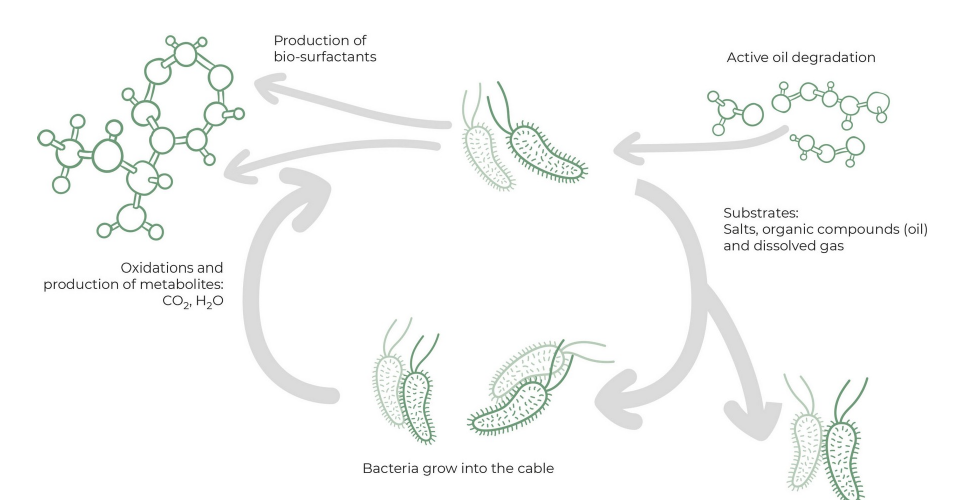
Biotech decontamination, across the hydrocarbon spectrum.
Different bacterial strains target different hydrocarbon classes. bionrec matches the culture to the contamination — from insulating oils in transmission cables to petroleum derivatives in soil, and specialist strains for aromatic and chlorinated compounds.
Long-chain aliphatic hydrocarbons
- —Lubricant oils
- —Engine oils
- —Insulating oils

Medium-chain aliphatic hydrocarbons
- —Diesel
- —Heating oil
- —Kerosene
- —Refining derivatives

Short-chain aliphatic hydrocarbons
- —Gasoline
- —Hexane
- —Octane
- —Solvents

Additional special bacteria
- —Organic aromatic compounds (BTEX)
- —Polyaromatic compounds (PAH)
- —Non-volatile chlorinated compounds (Dioxins)
- —Volatile chlorinated compounds (MTBE, ETBE)
- —PAH, C10–C40